

Narrow Gauge Railroads of Nevada.
Common Carrier Railroads.

Austin City Railway.
36" Gauge. The Austin City Railway was built in 1881 from the Nevada Central's terminal in Clifton to downtown Austin a distance of 2.8 miles. Operating on a heavy 7.5% grade, the line rostered a single 0-4-2T Dummy locomotive called "Mules Relief". The line operated until 1889 when reduced mining in the area forced the line to shut down.Clifton to Austin, Lander County. 1881 - 1889
Battle Mountain & Lewis.
36" Gauge. The Battle Mountain & Lewis began life in 1881 effectively as a privately owned branch of the Nevada Central Railway with service from Battle Mountain to the mines at Lewis, Nevada. Always in severe financial crisis the road became a rarely used and short lived branch of the Nevada Central Railway and was gone by 1890.Lewis Junction to Lewis, Lander County. 1881 - 1885
Carson & Colorado Railroad.
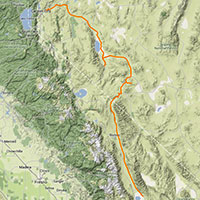
36" Gauge. Constructed by the Virginia and Truckee railroad to tap the southern mining booms. The line was projected to connect to the Colorado river, a feat it never accomplished, ending construction in Hawley, CA (later called Keeler). The line remained barely profitable until it was finally sold to the Southern Pacific in 1900, becoming the Nevada & California RR in 1905.Mound House, NV to Hawley (Keeler), CA. 1882 - 1905
Eureka & Palisade Railroad.
36" Gauge. Built to connect the booming mining district around Eureka with the Central Pacific at Palisade. Initially successful, the boom ended in 1885 and the smelters closed in 1890. An upswing in mining activity around 1900 revived the line briefly, until it the line was severely damaged by floods in 1910. The line was sold at auction and revived as the Eureka – Nevada Railway in 1912.Palisade to Eureka, Eureka County. 1873 – 1912
Golconda & Adelaide Railroad.
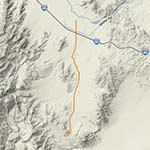
36" Gauge. Scottish investors organized the Glasgow & Western Exploration Company Ltd., in 1896 and invested in copper mines around Adelaide. In 1898 the company began construction on a railroad from the mine to the Central Pacific Railroad at Golconda. The expected boom never came and service over the railroad was intermittent until the railroad was finally abandoned in 1914.Golconda to Adelaide, Humboldt County. 1898 - 1914
Nevada & California Railroad.
36" Gauge. A traffic bottleneck on the C&C due mining booms in Tonopah and Goldfield lead the Southern Pacific Railroad to standard gauge portions of the Carson & Colorado. In 1905 the Hazen Cutoff was constructed to bypass the V&T connection at Mound House and a new terminal built in Mina NV.Mound House, NV to Keeler, CA . 1905 - 1912
Nevada Central Railroad.
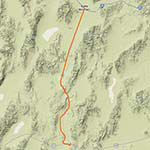
36" Gauge. Constructed to connect the rich mines in Austin and the Reese River Mining District with the Central Pacific at Battle Mountain. Initially profitable, the Nevada Central relied upon the mining in the area for traffic, profitable only when mines were operating at capacity. Mining tapered off by the early 1900s and the line hauled local goods until 1938.Battle Mountain to Austin, Lander County. 1879 - 1938
Nevada Short Line Railway.
36" Gauge. Constructed by the Rochester Hills Mining Company to connect the mines at Lower Rochester with the mill at Oreana on the Southern Pacific Railroad. The line was pushed further up a 7% grade to Upper Rochester and the mines on Nenzell Hill before financial woes put it into the hands of creditors. A flood in 1918 badly damaged the line and it was eventually sold for scrap in 1919.Oreana to Rochester, Pershing County. 1913 - 1919
Southern Pacific (Narrow Gauge).
36" Gauge. In 1912 the Nevada & California RR was reorganized into the Central Pacific Ry and operated as the Keeler Branch of the Southern Pacific system. Over the years the line would shorten as sections were abandoned until the Keeler to Laws portion remained. Affectionately known as the "Slim Princess".Mina, NV to Keeler, CA. 1912 - 1960
Tonopah Railroad.
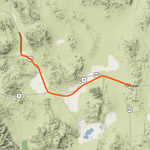
36" Gauge. Constructed by Eastern interests to connect the mining boom at Tonopah to the nearest railroad connection, the Carson and Colorado at Sodaville. The line remained narrow gauge for 13 months, hauling enough tonnage during this time to pay for half of its construction costs. With the opening of the Hazen Cutoff on the Southern Pacific, the Tonopah converted to standard gauge on August 14, 1905.Sodaville to Tonopah; Mineral, Esmeralda and Nye Counties. 1903 - 1905
Logging Railroads.
Lake Tahoe Narrow Gauge Railroad.
36" Gauge. Built by the Carson & Tahoe Lumber & Fluming Co. to supply lumber to the booming Comstock Lode. Timber was hauled down to the mill at Glenbrook and finished hauled lumber back up the ridge to Spooner Summit where it traveled by flume to their wood yard in Carson City. When the timber lands began to diminish, D. L. Bliss moved the operation to Tahoe City to construct the Lake Tahoe Railway & Transportation Co.Glenbrook to Spooner Summit, Ormsby County. 1875 - 1899
Sierra Nevada Wood & Lumber Company.
36" Gauge. Started by Walter Hobart and Seneca "Sam" Marlette to supply timber for the Comstock Lode. In 1875 a larger mill and incline was constructed to make use of the flume system and ship lumber to Lakeview on the Virginia & Truckee Railroad. The company constructed a railroad in 1879 connecting the new mill with the woods and later Sand Harbor. When the timber supply began to dwindle in the 1890s, the operation moved to Hobart Mills north of Truckee.Incline (Village) to Woods, later to Sand Harbor, Washoe County. 1878 - 1896
Mining Railroads.
Dayton, Sutro & Carson Valley Railroad.
36" Gauge. Initially constructed as the Lyon Mill & Mining Company, J.M. Douglas purchased the line from Fred Birdsall who had become interested in the San Joaquin & Sierra Nevada in California. The line operated a single locomotive, a Porter 0-4-2 named "Joe Douglas" until some time in the 1890's when operations ended, the exact date currently unknown.Dayton (C&C) to Rock Point Mill (Dayton, NV). 1881 - ca. 1900
Eureka Mill Railroad.
30" Gauge. Short by even shortline standards, this line was built by the Union Mill Co in 1872 due their Eureka Mill being in a location unreachable by the Virginia & Truckee along the Carson River. Initially horse drawn, a Porter 0-4-0T was purchased later. The mill burned down in 1892, leaving the railroad abandoned. Sometime after 1906 the equipment was sold and the 0-4-0T sold to a contractor, wound up abandoned in Butt Lake near Chester, California.Santiago Canyon to Eureka Mill. 1872 - 1906
Eureka & Ruby Hill Railroad.
36" Gauge. Constructed to connect the Eureka Consolidated Mines with their smelter operations in Eureka, in 1875 the line was purchased by the Eureka & Palisade Railroad. Under E&P control, trackage was expanded to the Richmond Consolidated Mine and associated Smelter. In 1893 operations were abandoned after the mines shut down. In 1902 operations resumed on a smaller scale until the flood which wiped out much of the E&P in 1910.Eureka to Ruby Hill, Eureka County. 1874 - 1893 and 1902 - 1910
Quartette Mining Company.
36" Gauge. Hauled gold ore from the Quartette mine near Searchlight to their stamp mill 16 miles away on the Colorado river. Discovery of a water source close to the mine lead to the construction of a new mill near the mine in 1906. Operations ceased on the railroad shortly thereafter, the remaining equipment and rails were sold between 1910 and 1915.Searchlight, Clark County. 1902 - 1908.
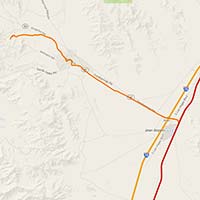
Yellow Pine Mining Company.
36" Gauge. Constructed to tap lead and manganese deposits west of Jean. The railroad hauled ore from the mines down steep grades to the smelter in Goodsprings for processing. The final product was then shipped down to Jean for transloading on the Los Angeles & Salt Lake Railroad (now Union Pacific). Ore shipments ceased by 1930 and the railroad was scrapped in 1934.Jean to Goodsprings, Clark County. 1911 - 1934
Industrial Railroads.
No Listings.
Transit Lines.
No Listings.
Oddities.
No Listings.
Tourist.